Baritone Dulcimer Day! Registration is now open!!

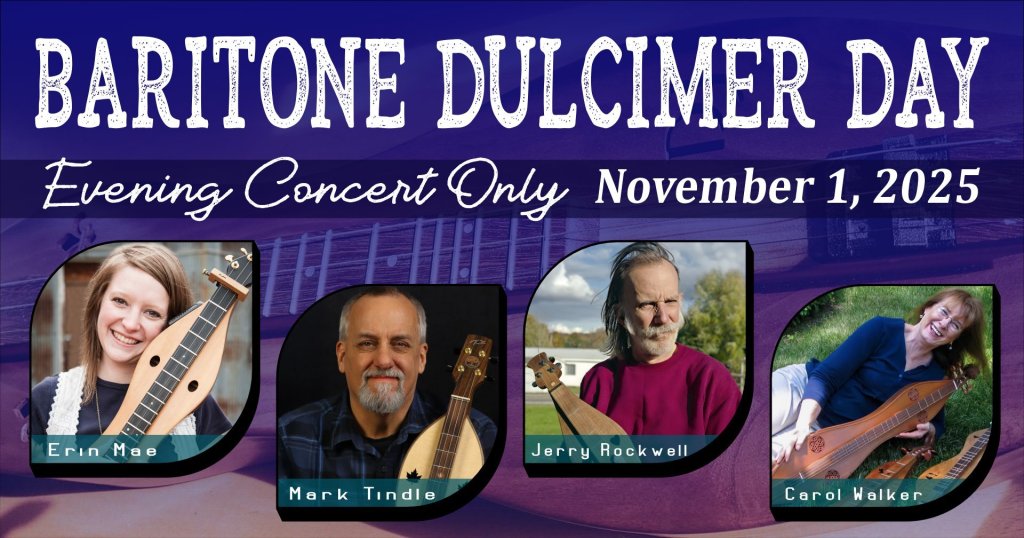
poster for the 4th annual Virtual

I’m really stoked to be part of this 4th Annual Baritone Dulcimer Day! This is a virtual event on Zoom, so no matter where you are, you will be able to participate. DJ Hamouris has done a great job of organizing this unique event so that all of us instructors can learn from each other’s workshops, and we can see each other’s concerts. How cool is THAT???

New EP at bandcamp!

This EP is partly a retrospective, with three tracks going back to 2019 and 2020 (Canterbury Lullaby, Jenny’s New Dreamscape, and The Light Always Comes), and two fairly recent tracks from earlier this year (Allison’s Infinite Round I, and Firefly Duet).

The three earlier tracks were remixed and remastered, and this took a lot more time than any other production in recent memory. I have taken advantage of the new mastering assistant in my Logic Pro Digital Audio Workstation, and I have made some progress in my audio engineering – particularly with getting levels balanced and consistent.

Most of these tunes have two or three tracks of electric dulcimer, with some standard DAD tuning, and some baritone AEAA tuning (Allison’s Infinite Round is tuned a whole step up to B-F#-B-B).

https://jerryrockwell.bandcamp.com/album/canterbury-lullaby-ep

Baritone Dulcimer Solo in AEAA Tuning | F# Aeolian Tablature

Here is a recent solo I recorded on my baritone dulcimer in AEAA tuning. This is very similar to the tablature I gave for B Aeolian in the last post, except for the fact that it is a 4th lower in F# Aeolian, and the last chord in the last measure is a G chord. In the F# version here, that same chord would be D.

And here is another take at a quicker pace:

Brand New EP at Bandcamp!

This is East Beach on Lake Erie in Lorain, Ohio. "Twilight At East Beach" is the title of my EP on Bandcamp

It has certainly been many moons since I released anything on bandcamp, but I’ve been working diligently on some more meditative dulcimer instrumentals, and I have a 4-tune EP ready now……just in time for “Bandcamp Fridays” (where the platform forgoes their share of revenue on the first Friday of most months).

These are some tracks that took more time for me to get exactly the right production, and I’m learning a lot about audio engineering with each track.

“Kate’s Waltz” is a 3/4 time version of my original “Kate’s Tune” which first appeared on my Singing Messenger album, way back in 2016. It is based on a mixolydian chord progression which was generated by a harmonized descending mixolydian mode. I have used this for many other titles, including “Blue Ridge Dream” (also in 3/4), “November’s Waltz” (from the early years of my Patreon lessons), and also the last track on this EP “Continuous Lines 218.”

“Magic Mountain Sanctuary” is a continuation of my “Magic Mountain Solitude” tracks, and I’m tuned a half step up from my usual DAD tuning – to Eb – Bb – Eb. The chords are a stretched out version of the “cabbage chords” (well-known to many dulcimer players!), and there is an arpeggiated keyboard track in the background to set the groove.

The title track “Twilight At East Beach” is inspired by a beautiful beach on Lake Erie, in Lorain, Ohio, not too far from Cleveland. This one is actually in the key of F and uses an 8-bar progression I constructed from joining two 4-chord loops. These days, I usually play in the key of F by tuning CGC and keying off of the F chord as the center, but not using a capo. This track has a few synth pads to create a backdrop for the very high-pitched dulcimer melodies.

Anyway, here you go if you want to check it out. Thanks for listening!

Twilight At East Beach EP
Harmonized Scales and Modes

I have learned SO MUCH from harmonizing the descending form of the major scale, the aeolian mode, the dorian mode, and the mixolydian mode. In the DAD tuning, I start with the D Major Scale up at the 7th fret of the bass string, and move down the fingerboard to 6+, then 5–4–3–2–1–0. The basic idea is to build a chord on each bass note, using mostly the primary triads (D, G, and A or I, IV, and V). I usually like to put Em in place of the G the second time around. to give things a touch of color and to add a little variety.

Here is a 2-page pdf in waltz time with two measures on each chord. The first 16 bars of each exercise has block position chords, and the arpeggios follow below. You can make up your own arpeggios for this as well: be creative!! .

Learning Chords in DAD Tuning (Part 2)

In the first installment of our D Major chord exercises, we took a look at some of the most basic ways to play the D-G-D-A-D sequence of chords. This time we’ll try some ascending chord forms to give a little variety and movement to the progression.

Now you might be wondering what else you can do with these chords once you try these specific forms. I think one of the first ideas that comes to mind is the universal “Cabbage Chords” progression. Many beginning students of the dulcimer learn the chorus part to the folk song “Bile Dem Cabbage Down” before they learn any other chords:

Now these chords go by pretty quickly, and one way to make them last longer is to “stretch-out” the progression so there is twice as much time on each of the chords. (I have always called this the “Stretched Cabbage Progression”). You can also try the progression in 3/4 time as a waltz……it makes a great Country Waltz!!

Magical, Peaceful Instrumentals Playlist

This is one of my favorite playlists of the ones I curate myself on Spotify. It has a wide variety of instruments and genres, but the common theme is a simple, folk-oriented approach to melody and harmony. You’ll hear some minimal pieces on piano by some of my favorite players, some great accordion work by the amazing Maria Kalaniemi, or some mesmerizing modal compositions by Whalebone (UK-based ensemble).

Some New Tunes!

Golly, this quarantine has led to a whole bunch of creative work from so many artists all over the planet! I have been incredibly busy too: working on formatting block chord TAB in a table format on this blog (A LOT harder than you might think!!!), learning Finale (for the 3rd or 4th time!), and laying some new track ideas in Logic Pro X, which is the subject of this post.

Here is a tune I recorded a few days ago:

SummerTune No. 1